
DATA + STRUCTURE = DATA STRUCTURE
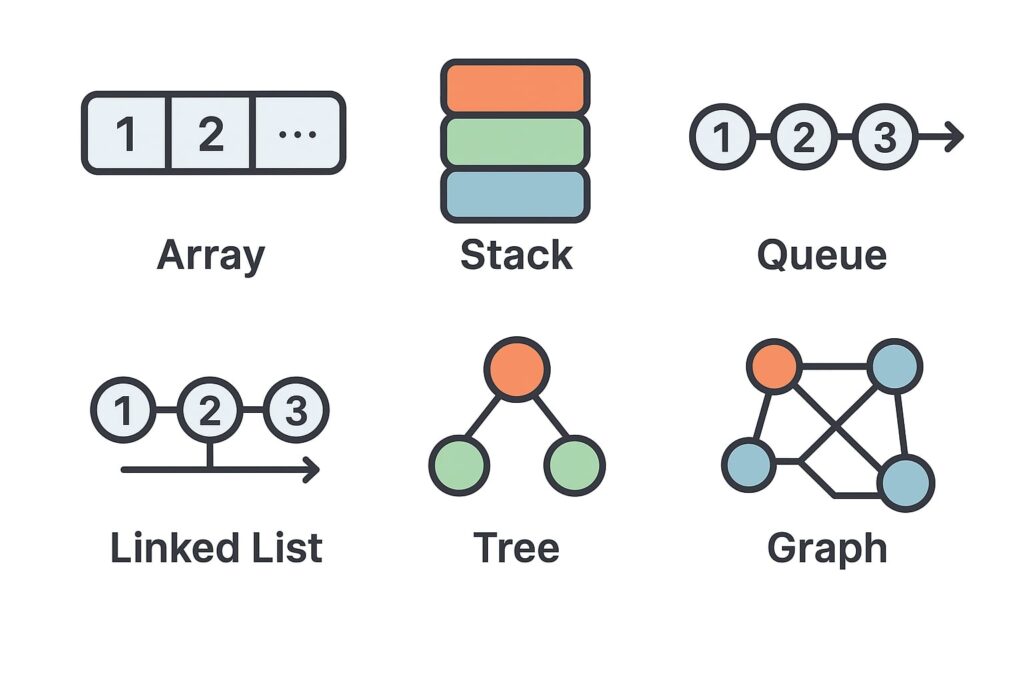
A Data Structure is a way to store, organize, and access data efficiently so that it can be used effectively.
Example:
- Array – stores elements in a continuous memory.
- Stack – follows Last In, First Out (LIFO).
- Queue – follows First In, First Out (FIFO).
- Linked List,Tree, Graph ,etc
In Simpler Words we can say that it is way to store data and accessing of Data.
Algorithm:
It is a step-by-step procedure or set of instructions used to solve a problem or perform a specific task
Example:
Algorithm To make tea :-
- Boil water.
- Add tea leaves.
- Add milk and sugar.
- Stir and serve.
Why we want to Learn DSA?
Learning DSA is like making a strong foundation for strong bridge or we can say it is like learning the grammar of the coding without it you cannot speak the language of programming fluently.
Learning DSA is one of the most important steps for every programmer or computer science student. Here’s why:
->Builds Strong Problem-Solving Skills:
DSA helps you think logically and break down complex problems into smaller, manageable parts.
->Improves Code Efficiency:
Using the right data structure or algorithm makes your code faster and uses less memory.
->Crucial for Placements & Interviews:
Almost every top company (Google, Amazon, Microsoft, etc.) asks DSA-based questions in coding interviews.
->Foundation for Advanced Topics
DSA is the base for AI, Machine Learning, Web Development, and System Design — everything in tech connects back to it.
->Helps You Write Optimized Code
DSA teaches you how to choose the best solution among many possibilities — improving performance and scalability.
->Enhances Logical Thinking
Practicing DSA regularly improves your logic, reasoning, and analytical skills, which are key to being a great programmer.
->Universal Programming Language Skill
Once you learn DSA, it doesn’t matter whether you code in C, C++, Java, or Python – the logic stays the same.
How to learn DSA?
Here it is the step by step guide to learn DSA:-
Learning DSA can feel tough at first -but if you follow the right roadmap, it becomes super manageable and even fun.
Step 1: Learn the Basics of Programming:
Before jumping into DSA, make sure you know at least one programming language well (like C++, Java, or Python).
Learn basics like:
- Variables, loops, and conditionals
- Functions
- Arrays and strings
- Input/output
Tip: Choose one language and stick with it throughout your DSA journey.
Step 2: Understand Core Data Structures:
Start learning one by one and implement each from scratch.
Essential Data Structures:
- Arrays
- Strings
- Linked Lists
- Stacks
- Queues
- Hash Maps / Hash Tables
- Trees (Binary & Binary Search Trees)
- Heaps / Priority Queues
- Graphs
Practice each by writing small programs — insert, delete, search, traverse, etc.
Step 3: Learn Important Algorithms:
Once you understand data structures, move on to algorithms — the logic behind solving problems.
Start with:
- Searching (Linear, Binary Search)
- Sorting (Bubble, Selection, Merge, Quick Sort)
- Recursion & Backtracking
- Divide and Conquer
- Greedy Algorithms
- Dynamic Programming
- Graph Algorithms (DFS, BFS, Dijkstra, etc.)
Focus on understanding the logic, not memorizing code.
Step 4: Practice Problems Daily
Consistency is key .
Platforms to Practice:
- LeetCode
- GeeksforGeeks
- HackerRank
- CodeStudio
Try to solve 1–2 problems daily — start easy, then move to medium and hard.
Step 5: Learn Time and Space Complexity
Understand Big O Notation (O(n), O(log n), O(n²)) — it tells you how fast your algorithm runs.
This helps you write optimized code that works efficiently even for large inputs.
Step 6: Join a Community
Join DSA study groups or Telegram channels to:
- Discuss problems
- Get help when stuck
- Stay consistent and motivated
Step 7: Build Projects Using DSA Concepts
Once you get confident, try mini-projects that use data structures:
- Contact Manager (using linked list or hash map)
- Mini Search Engine (using trees or tries)
- Path Finder (using graph algorithms)
Step 8: Revise & Repeat
DSA is a long-term skill — so keep revising old topics while learning new ones.
The more you code + revise + apply, the better you’ll get.